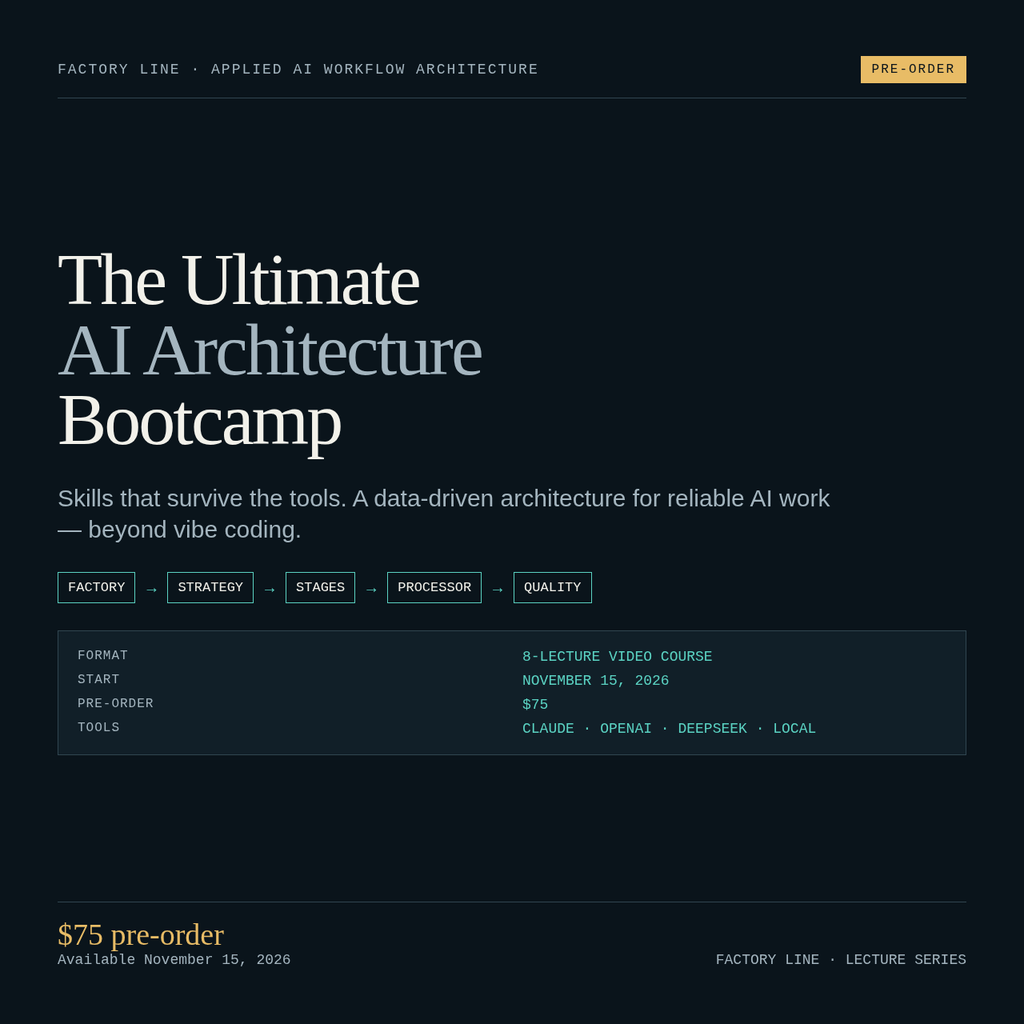
The Ultimate AI Architecture Bootcamp
Build AI work that survives the tools.
A design course for experienced developers and architects who want reliable AI workflows — not another prompt library. One architecture, eight lectures, independent of any model or vendor.
Watch the overview: why vibe-coded prototypes break down, and how the Factory Line data-driven architecture works.
The eight lectures
One continuous build, not eight disconnected topics. Each lecture adds the next layer of the same architecture.
Trace every AI deliverable to its job, source, context, provider, prompt, reviewer, and owner.
Store work, assets, context, and approvals in typed tables — no JSON bag, no schema-on-read shortcut.
Factories, strategies, stages, processors, adapters, jobs, artifacts, publishers, and the workspace.
Dependencies, handoffs, gates, conditional routes, and the difference between a plan and execution evidence.
Compose the right craft for the job, and only the layers that are selected or required.
Define, measure, analyze, improve, and control. A score is not human approval; a job is not a release.
Retries, idempotency, budgets, provider credentials, tenant boundaries, and the evidence to operate under load.
Build your own reliable AI workflow, choose an adoption path, and prove the result with real jobs and real artifacts.
Built from real work, not slides alone
The patterns come from almost four years of continuous work on one conceptual framework, tested against real jobs, real artifacts, and real failures. The course uses live Factory Line records: the narration job, assembly job, Quality assessment, factory and strategy records, context layers, stages, and processors. The same engine runs video composition, game production, franchise operations, and Odoo course + YouTube publication.
The architecture is tool-independent. Use Claude, OpenAI, DeepSeek, or a local model. Use the tools your team already has. The architecture is the part that stays; the vendor is the part that changes.
Who this is for
You ship AI features and want a durable architecture instead of another vendor-coupled prototype.
You need provenance, contracts, evaluation, and operations to coexist with the tools your teams already use.
You want the team to stop rebuilding job queues, retries, reviews, and model-calling code for every workflow.
Serious beginners are welcome. The course gives you the map before the tools; senior engineers will still find techniques that change how they structure production work.
Your instructor
Greg Moss has spent forty years building enterprise architecture software, including SaaS platforms used by thousands of similar users, integration layers that had to survive vendor changes, and workflows where the audit trail mattered as much as the feature. The through-line is simple solutions to complex problems: explicit boundaries, data that describes the work, and code that executes the mechanics.
Questions
Do I need to buy the Factory Line platform?
No. You can implement the architecture with the tools you already use, use it as a blueprint, or adopt selected components. The goal is the skill.
Is this a prompt library?
No. It is a design course about the architecture around the model: provenance, context, contracts, stages, processors, Quality, operations, and accountable release.
Which models or tools are required?
None specifically. The patterns are tool- and model-independent. Examples use Factory Line, but the principles apply to your own stack.
When does the course start?
Course access opens November 15, 2026. The overview video is available now.
Course access opens November 15, 2026. Use the Add to Cart button at the top of this page to reserve your seat.